
Africa stands at the forefront of global copper production, home to some of the world’s largest and most geologically complex deposits, such as the Central African Copper Belt. The efficient extraction and processing of this vital metal begin with a critical first step: primary size reduction. In the demanding environment of African copper mining, the Jaw Crusher is not merely a piece of equipment—it is the foundational workhorse upon which the entire downstream comminution and beneficiation process depends. This article explores the indispensable role and strategic advantages of jaw crushers in these high-stakes projects.
1. The African Copper Mining Context: Challenges for Primary Crushing
Copper mining in Africa presents a unique set of operational hurdles that directly impact equipment selection for the primary stage:
- Hard and Abrasive Ore: Copper ores, often hosted in hard rock like granite or shale, are highly abrasive, leading to severe equipment wear.
- High Throughput Requirements: Large-scale, open-pit mines require primary crushers capable of processing thousands of tons of material per hour reliably.
- Harsh Environmental Conditions: Operations face dust, high ambient temperatures, and, in some regions, high humidity or seasonal rainfall.
- Remote Locations and Infrastructure Constraints: Sites may have limited grid power, scarce water for dust suppression, and logistical challenges for spare parts and expert maintenance support. Reliability and simplicity are paramount.
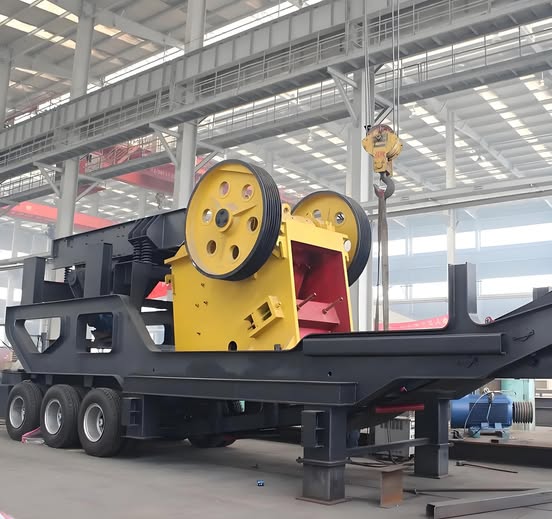
2. Why the Jaw Crusher is the Preferred Primary Solution
In this challenging context, the jaw crusher’s fundamental design principles make it the optimal choice for the first line of attack against run-of-mine (ROM) copper ore.
a) Unmatched Robustness and High Breaking Force
The jaw crusher’s mechanism—a fixed jaw and a robust, reciprocating moving jaw—applies immense compressive force directly to the rock. This makes it exceptionally effective at fracturing the large, hard, and blocky copper ore (often up to 1.5 meters in size) delivered by haul trucks from the pit. Its heavy-duty construction is engineered to withstand the shock loads from dumping such material.
b) High Reliability and Mechanical Simplicity
For remote African operations, uptime is a direct driver of profitability. Jaw crushers have a straightforward mechanical design with fewer complex systems compared to some alternatives. This translates to:
- High Mechanical Availability: Less prone to catastrophic failure.
- Easier Troubleshooting and Maintenance: Local crews can be trained effectively on routine maintenance and wear part replacement.
- Predictable Wear Patterns: Primary wear occurs on the replaceable jaw dies, allowing for planned maintenance shutdowns.
c) Adaptability to Variable Feed Conditions
The feed from a mining shovel or truck can be inconsistent in size and may contain some oversize or wet, sticky material. Jaw crushers are generally more forgiving of these fluctuations than gyratory crushers, with a lower risk of bridging or choking, ensuring a steady feed to the downstream process.
d) Lower Initial Capital Investment (CAPEX)
For many medium-to-large scale projects, a high-capacity jaw crusher offers a favorable balance of performance and capital cost compared to a gyratory crusher of similar capacity, making it a financially strategic choice.
3. Core Functions and Strategic Impact on the Processing Line
The jaw crusher’s role extends beyond simply breaking rock; it sets the operational tempo for the entire mineral processing plant (MPP).
- Primary Size Reduction: It performs the initial, coarse reduction of ROM ore, typically producing a product with a top size of 150-250 mm. This creates a manageable feed for the secondary crushing circuit (usually cone crushers).
- Establishing Plant Throughput: The capacity of the primary jaw crusher is a key bottleneck that defines the maximum potential processing rate of the entire concentrator.
- Influencing Downstream Efficiency: By providing a consistent and optimally sized feed, it allows secondary and tertiary crushers, as well as SAG or ball mills, to operate at their peak efficiency, optimizing overall energy consumption—the single largest operating cost in comminution.
4. Key Configuration Considerations for African Projects
To maximize effectiveness, the selection and setup must be tailored:
- Choosing the Right Model and Jaw Die Metallurgy: Selecting a crusher with adequate size and power, and equipping it with premium manganese steel jaw dies specifically formulated for abrasive conditions, is critical for extending wear life.
- Integration with a Vibrating Grizzly Feeder (VGF): A VGF placed ahead of the crusher is essential. It scalps out fine material (which may bypass primary crushing) and ensures a regulated, even feed, protecting the crusher and boosting effective capacity.
- Focus on Dust Control and Cooling: Effective dust suppression systems (water sprays, enclosures) are vital for environmental compliance, equipment health (especially bearings), and operator safety. Ensuring adequate cooling for lubrication systems is crucial in hot climates.
- Spare Parts Strategy: Given logistical challenges, maintaining a strategic on-site inventory of critical wear parts (jaw dies, toggle plates, bearings) is a non-negotiable aspect of operational planning.
Conclusion: The Indispensable Foundation for Copper Production
In the high-value, high-throughput world of African copper mining, the jaw crusher fulfills a role of strategic importance. It is the robust, reliable, and efficient gateway that transforms blasted ore into a controlled stream of material, enabling all subsequent value-adding processes.
Its proven ability to deliver under the continent’s toughest conditions—processing hard rock with high availability—makes it more than just a machine; it is a fundamental asset for operational stability and profitability. Investing in the correct jaw crusher, supported by a robust maintenance and logistics plan, is one of the most critical decisions in ensuring the long-term success and cost-efficiency of any major copper mining project in Africa.
- > High-Efficiency 1000 TPH Mobile Limestone Crusher in South Africa
- > Cone Crushers for Coal Processing in Morocco
- > Jaw Crushers for Quarrying: Power, Efficiency, and Durability
- > Can a Crawler Mobile Crushing Station Be Used for Construction Waste Recycling?
- > Highly Recommended Impact Crusher for Stone Crushing
- > Which crushing machine is suitable for wet and sticky materials
- > Applications of Mobile Cone Crushers in Secondary Crushing for Sand and Gravel Aggregate Plants
- > Which Crusher to Use for Manufactured Sand Production? A Complete Guide


Online


Message