
In mining and large-scale quarrying operations, the primary crushing stage sets the foundation for all downstream processes. It faces the most daunting task: accepting massive, irregularly shaped blocks of raw ore—often exceeding 1 meter in size—and reliably reducing them to a manageable size for secondary crushing. For this critical and punishing duty, the jaw crusher has been and remains the predominant and preferred first-line solution. Its selection is not a matter of tradition, but a calculated decision based on engineering principles that match the extreme demands of large ore blocks. This article provides a technical analysis of the key reasons why jaw crushers are the first choice for primary crushing of large ore.
The Challenge: Understanding the Primary Crushing Environment
Primary crushers operate under the harshest conditions:
- Extreme and Variable Feed Size: Run-of-mine ore can contain boulders up to 1.5m in diameter.
- High Strength and Abrasiveness: Ores are often very hard and abrasive (e.g., iron ore, copper porphyry, granite).
- Unpredictable Feed: Material may contain occasional tramp metal or exhibit variable moisture and clay content.
- Requirement for Unmatched Reliability: Downtime at this stage halts the entire processing plant.
The equipment must be, above all else, robust, reliable, and capable of absorbing massive shock loads.
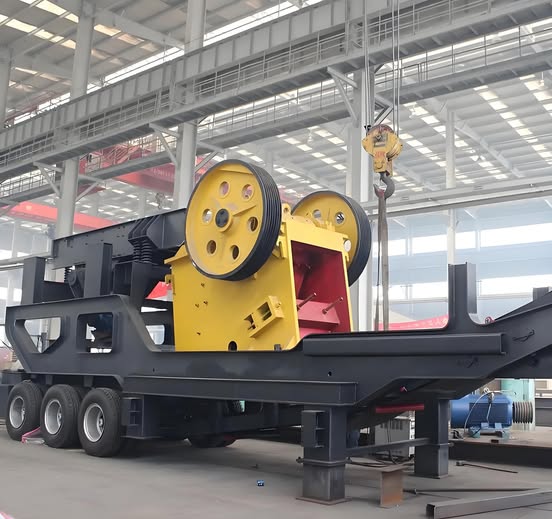
Core Reasons for Selecting a Jaw Crusher
1. Superior Breaking Force and Simple, Powerful Mechanics
The jaw crusher’s operating principle is direct and perfectly suited to the task: immense compressive force.
- Linear Crushing Action: Two robust jaw dies—one fixed, one moving in an elliptical motion—apply tremendous pressure, literally squeezing the rock until it fractures. This linear, “nipping” action is highly effective against large, hard blocks where impact-based crushing might be less efficient or cause excessive wear.
- High Reduction Ratio in One Stage: A well-configured jaw crusher can achieve a primary reduction ratio of 6:1 to 8:1 in a single pass, efficiently preparing feed for the next stage.
2. Unmatched Robustness and Ability to Handle “Anything That Fits”
- Heavy-Duty Construction: The design is fundamentally simple yet incredibly strong. It features a heavy-duty fabricated or cast steel frame, oversized eccentric shafts, and large anti-friction bearings. This build is engineered to withstand the cyclical stresses of crushing the toughest materials for decades.
- Tolerance for Oversize and Tramp Metal: The geometry allows it to accept large slabs and blocks without pre-screening. While not immune, its design is more forgiving of occasional oversize or non-crushable material than other primary crusher types, with simpler protection systems (e.g., toggle plates designed to break under overload).
3. Operational Simplicity and Ease of Maintenance
- Easy Access and Wear Part Management: The primary wear parts—the jaw dies—are relatively easy and quick to replace compared to the internal liners of a gyratory crusher. This minimizes critical downtime (MTTR). Many jaw dies are reversible to utilize multiple wear surfaces.
- Lower Technical Complexity: With fewer complex internal mechanisms than a gyratory crusher, maintenance routines are generally more straightforward, requiring less specialized training for basic servicing.
4. Lower Installation Height and Capital Cost (CAPEX) Flexibility
- Foundation and Infrastructure: Jaw crushers require a less massive and complex foundation structure than gyratory crushers, which are taller and heavier. This translates to lower initial civil engineering costs and easier installation, especially in greenfield sites or mobile/semi-mobile configurations.
- Mobile Primary Crushing: The jaw crusher is the undisputed king of track-mounted primary crushing units. Its compact profile and efficiency make it ideal for “move-in, crush, move-out” operations, bringing the primary crushing stage directly to the mining face.
Conclusion: The Foundational Pillar of Mineral Processing
The preference for jaw crushers as the primary choice for crushing large ore blocks is a well-founded conclusion based on engineering pragmatism and total cost of ownership. They offer the optimal balance of raw crushing power, exceptional durability, operational simplicity, and installation flexibility.
While gyratory crushers hold an advantage in ultra-high-capacity stationary applications, the jaw crusher’s versatility, reliability, and cost-effectiveness make it the cornerstone of primary crushing for the vast majority of operations worldwide. Investing in a correctly sized, heavy-duty jaw crusher is an investment in a stable, predictable, and profitable first step in the comminution circuit—a true testament to the enduring power of a brilliantly simple mechanical design.
Evaluating your primary crushing needs for large ore blocks? Consult with our crushing experts to select the jaw crusher model and configuration that will deliver the highest availability and lowest cost per ton for your specific material and production goals.
- > Efficient Crushing Solutions for High-Moisture Copper Ore in Indonesia Using Jaw Crushers
- > Crushers in Gold and Platinum Mining: Streamlining the Extraction Process
- > The Role of Mobile Construction Waste Crusher in Road Renovation Projects
- > High-Efficiency Vibrating Feeder for a 50 TPH Stone Production Line: Essential for Consistent Material Flow
- > High-Efficiency 1000 TPH Mobile Limestone Crusher in South Africa
- > The Role of Impact Crushers in Sand and Gravel Aggregate Production
- > Deep Cavity Jaw Crusher for Basalt Processing: High Efficiency and Durability
- > Mobile Jaw Crusher for Copper Ore Processing in Ukraine: Enhancing Efficiency and Flexibility


Online


Message