
Choosing the correct jaw crusher model is a foundational decision for any mining or aggregate processing operation. The hardness of the ore is the single most critical factor influencing this choice, as it directly impacts the crusher’s capacity, wear life, energy consumption, and ultimately, the project’s profitability. Selecting an underpowered crusher leads to bottlenecks and excessive wear, while an oversized model wastes capital and energy. This guide provides a systematic approach to matching jaw crusher specifications with the hardness of your ore for optimal performance and cost-efficiency.
1. Understanding Ore Hardness: Key Metrics
Before selecting a crusher, you must quantify the hardness of your material. Relying solely on terms like “hard” or “soft” is insufficient. Use these standard measurements:
- Bond Work Index (Wi): The most relevant and scientific metric for crusher selection. It measures the energy (in kilowatt-hours per ton) required to reduce ore from a theoretically infinite feed size to 80% passing 100 micrometers. Higher Wi values indicate harder, more abrasive material.
- Soft: Wi < 10 kWh/t (e.g., limestone, coal)
- Medium: Wi 10-15 kWh/t (e.g., iron ore, dolomite)
- Hard/Abrasive: Wi > 15 kWh/t (e.g., granite, quartzite, basalt, copper sulphide ores)
- Uniaxial Compressive Strength (UCS): Measured in MPa (Megapascals), it indicates the force required to crush a rock sample. Commonly used in geotechnical engineering.
- Mohs Scale: A relative scale of mineral hardness (1-10). Useful for quick reference but less precise for engineering calculations (e.g., quartz is 7, talc is 1).
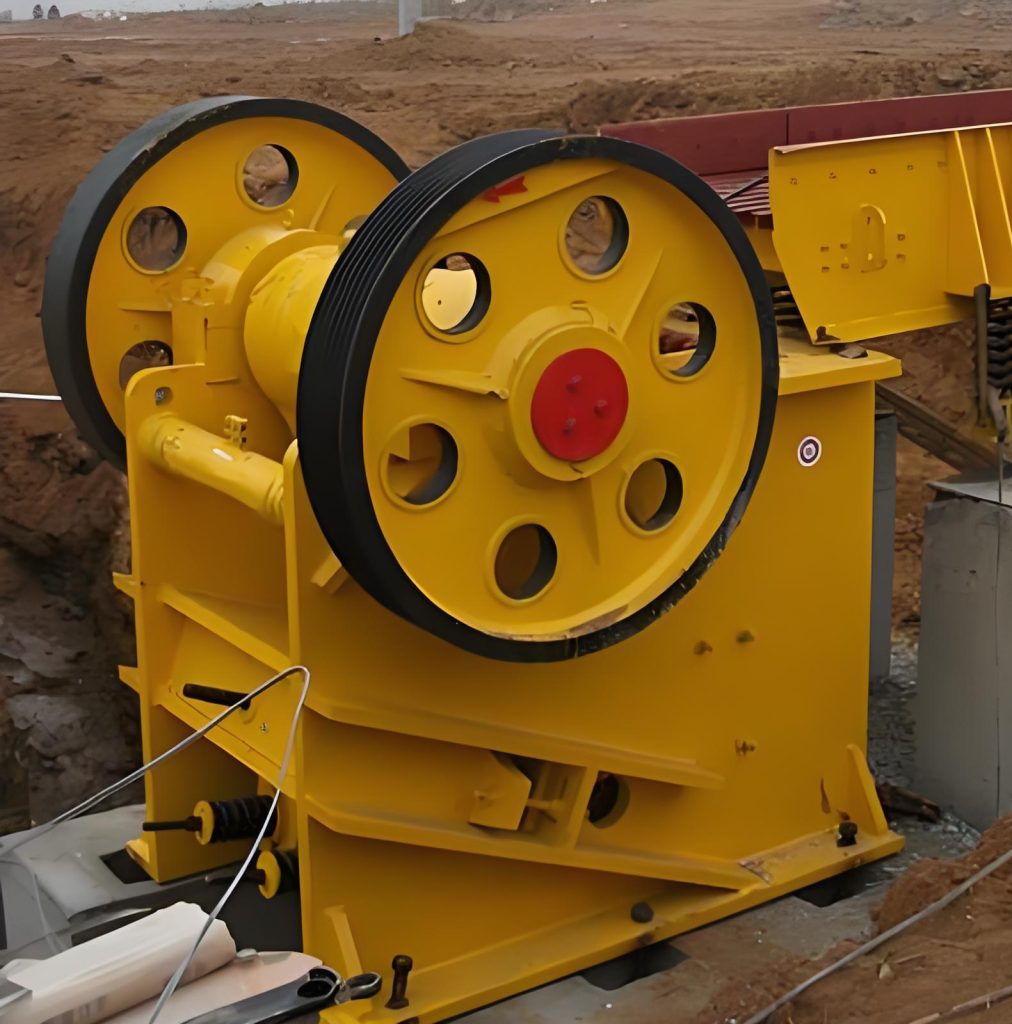
2. Core Jaw Crusher Specifications Affected by Hardness
Hardness influences the selection of the following crusher parameters:
a) Crusher Size & Feed Opening
Harder ores require more energy and time to fracture. To achieve the same target throughput as with softer rock, you often need a larger, more powerful crusher with a bigger feed opening to handle the necessary volume and larger feed size without overstressing the machine.
b) Power & Capacity Ratings
Manufacturers provide capacity tables for different materials. Never use the “soft stone” capacity rating for hard, abrasive ore. Always refer to the hard stone or specific capacity chart based on the material’s Bulk Density and Work Index. A crusher rated at 500 tph for limestone may only achieve 300 tph for granite.
c) Toggle & Frame Strength
The crushing force required for hard rock is immense. The crusher must have a robust, heavy-duty frame and a strong toggle plate/system (mechanical or hydraulic) to withstand the high cyclic stresses without fatigue or failure.
d) Jaw Die (Liner) Metallurgy
This is a critical wear component. For highly abrasive ores, specify premium manganese steel alloys with enhanced work-hardening properties or specialized composite liners. The correct metallurgy significantly extends service life and controls operational costs.
3. Step-by-Step Selection Guide Based on Hardness
Step 1: Conduct Ore Testing
Obtain a representative sample and have it tested to determine its Bond Work Index (Wi), abrasion index (Ai), and bulk density. This data is non-negotiable for accurate selection.
Step 2: Define Your Production Goals
Determine your required maximum feed size (from the mine/blast) and desired product size (discharge setting/CSS). Calculate the necessary hourly and annual tonnage.
Step 3: Apply Hardness to Capacity Calculations
Use your ore’s Work Index (Wi) in conjunction with the crusher manufacturer’s selection software or capacity formulas (like those derived from Bond’s Third Theory). This will generate a realistic Expected Throughput (tph) for each crusher model you evaluate.
Step 4: Evaluate Key Model Specifications
For Hard/Abrasive Ore (Wi > 15):
- Priority: Robustness, Power, Wear Life.
- Look for: Heavy-duty construction, high installed power (kW), deep crushing chambers, and options for heavy-duty jaw dies. Consider models with a steeper nip angle for better grip on hard, slabby rock.
- Example: You will likely need a larger, more powerful model (e.g., a 48″x60″ instead of a 42″x50″) to meet your tonnage target compared to processing softer rock.
For Medium-Hard Ore (Wi 10-15):
- Priority: Balanced performance and cost.
- Look for: Standard heavy-duty series with adequate power reserves. Focus on efficiency and total cost of ownership.
For Soft to Medium Ore (Wi < 10):
- Priority: High capacity and operational economy.
- Look for: Crushers optimized for higher throughput and lower energy consumption per ton. Lighter liner profiles may be acceptable.
Step 5: Consult with Manufacturers & Review References
Present your ore test data and production requirements to reputable manufacturers. Request site-specific capacity calculations and ask for references from similar applications (similar ore type and hardness). Compare their technical proposals.
4. Critical Supporting Factors
- Feed System: Always pair the crusher with a vibrating grizzly feeder (VGF). For hard ore, this is essential to scalp out fines (which consume chamber space without being crushed) and ensure a steady, controlled feed rate, protecting the crusher from shock loads.
- Discharge Setting: A narrower Closed Side Setting (CSS) produces a finer product but reduces capacity and increases wear, especially on hard ore. Ensure your selected model can achieve your target product size at the required throughput.
- Safety Margin: For hard ore applications, it is prudent to select a crusher with a 10-20% capacity buffer above your calculated need to account for ore variability, future expansion, and maintaining throughput as jaw dies wear.
Conclusion: A Data-Driven Investment
Selecting a jaw crusher model based on ore hardness is not a guessing game; it is a data-driven engineering process. Investing in accurate ore testing and applying the results to rigorous capacity analysis is the only way to ensure a successful, cost-effective installation.
The right choice—a crusher whose strength, power, and size are aligned with the challenges of your specific ore—will deliver maximum availability, controlled wear costs, and optimal energy efficiency. This disciplined approach minimizes operational risk and lays the most reliable foundation for your entire comminution circuit, turning the inherent challenge of hard rock into a predictable and profitable process.
- > The Role of Mobile Crushers in Bridge Construction
- > Efficient Crushing Solutions for High-Moisture Copper Ore in Indonesia Using Jaw Crushers
- > Impact Crusher Working Principle: A Simple Guide to How It Works
- > Sand Production Line Equipment Configuration
- > Application of Cone Crusher in Granite Crushing Production Line
- > Jaw Crusher Optimization for Indonesian High-Moisture Clay-Type Nickel Ore
- > Advantages of Impact Sand Making Machines in Construction Aggregates
- > Should an Impact Crusher or a Cone Crusher be used for crushing river pebbles into sand?


Online


Message