
In the demanding world of gold mining and mineral processing, efficient and reliable comminution is paramount. After primary crushing, the secondary and tertiary stages are critical for liberating gold particles and preparing the ore for downstream concentration or leaching processes. For these stages, particularly with hard, abrasive, and variable gold ores, the hydraulic cone crusher has emerged as the equipment of choice. Its advanced design offers a unique combination of power, precision, and protection, delivering performance metrics that directly impact plant profitability. This article analyzes the key performance characteristics of hydraulic cone crushers in gold ore crushing circuits.
The Challenge: Characteristics of Gold-Bearing Ore
Gold ore is notoriously challenging to process efficiently. Its characteristics often include:
- High Hardness & Abrasiveness: Many deposits, especially quartz vein-hosted gold, are extremely hard (high compressive strength) and abrasive due to high silica content. This causes rapid wear in crushing chambers.
- Variable Feed: Ore composition and hardness can fluctuate significantly within a single deposit or even a single load.
- Presence of Tramp Metal: Uncrushable objects from mining operations pose a constant risk of catastrophic damage.
- Requirement for Consistent Product Size: Optimal performance in milling (e.g., SAG/Ball Mills) or leaching (e.g., heap leach) requires a finely crushed, consistent feed.
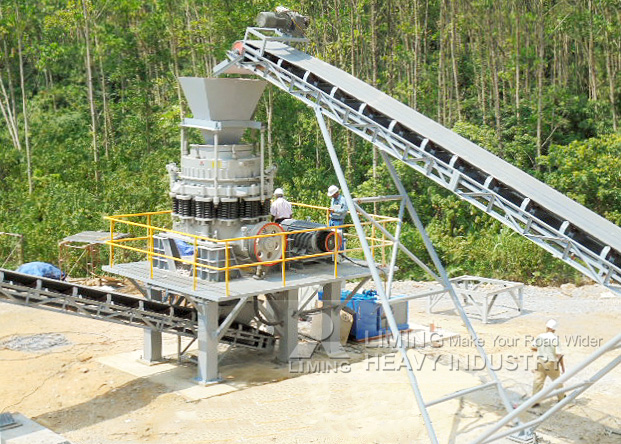
How Hydraulic Cone Crushers Excel in Gold Ore Applications
Hydraulic cone crushers, particularly modern multi-cylinder models, are engineered to meet these challenges head-on.
1. Superior Particle Shape and Size Control (Liberation)
- Lamination (Inter-Particle) Crushing: The principle of compressing rock between the mantle and concave, combined with rock-on-rock crushing in a packed chamber, produces a product with excellent cubical shape. This optimal shape is crucial for efficient downstream processes like cyanide leaching, as it allows for better percolation in heaps or more uniform slurry in tank leaching.
- Hydraulic Adjustment Under Load: The CSS (Closed Side Setting) can be adjusted in real-time, even during operation and under full load. This allows operators to precisely control the top size of the product and, critically, to automatically compensate for liner wear, ensuring a consistent product size over the entire liner life. This stability is vital for grinding circuit optimization.
2. Unmatched Operational Stability and Protection
- Advanced Hydraulic System: The core of its performance. It provides:
- Overload Protection (Automatic Clearing): In milliseconds, the system can release the crushing chamber to pass tramp metal or an uncrushable “slug” of ore and then automatically reset to the original CSS. This prevents costly downtime and major mechanical damage, a critical feature in remote mining locations.
- Constant Liner Cavity: The hydraulic clamping cylinders hold the main shaft in a fixed position relative to the bowl, maintaining optimal cavity geometry for consistent crushing force and product gradation.
- High Reduction Ratio and Capacity: Capable of achieving significant size reduction in a single pass, they efficiently handle the high volumes required in gold processing plants, feeding SAG mills or preparing fine feed for leaching.
3. Wear Management and Serviceability for Abrasive Ores
- Robust Liner Design: Liners are made from high-grade manganese steel or specialized alloys designed to withstand severe abrasion. Advanced models offer liner profiles optimized for fine crushing and extended life in abrasive conditions.
- Reduced Downtime: Features like hydraulic cavity clearing, top service access, and sometimes hydraulic rotation of the bowl, significantly reduce the time and manpower required for maintenance and liner changes, increasing overall plant availability.
Typical Applications in a Gold Processing Circuit
- Secondary Crushing: Reducing primary crusher product (e.g., from a jaw crusher at ~150mm) to a size suitable for feeding a grinding mill or tertiary circuit (~25-50mm).
- Tertiary/Fine Crushing: Producing a finely crushed product (e.g., -12mm or -6mm) for:
- Heap Leach Operations: Creating a uniform, permeable crush size for optimal gold recovery via cyanide solution.
- Mill Feed Preparation: Providing a consistent, finely crushed feed to ball mills to improve grinding efficiency (applying the “crush more, grind less” energy-saving principle).
- Pebble Crushing: In SAG mill circuits, hydraulic cone crushers are ideal for crushing the critical-sized “pebbles” recirculated from the SAG mill discharge.
Conclusion: A Strategic Asset for Gold Recovery
The performance of a hydraulic cone crusher in a gold ore crushing circuit is defined by its reliability, precision, and resilience. Its ability to maintain a stable, finely-tuned product size while automatically protecting itself from damage translates directly into higher plant throughput, reduced operating costs, and maximized gold recovery rates.
For mine operators, investing in this technology is not merely an equipment purchase; it is an investment in circuit stability, operational predictability, and lower cost per processed ton. In an industry where throughput and recovery percentage are the ultimate measures of success, the hydraulic cone crusher proves to be an indispensable tool for optimizing the crucial comminution stage.
Looking to optimize your gold ore crushing performance? Contact our mineral processing experts to analyze your ore characteristics and circuit design for a hydraulic cone crusher solution that maximizes your recovery and return on investment.
- > Maximizing Efficiency with the Most Advanced Vibrating Feeders in the Mining Industry
- > Efficient 100-150 TPH Cone Crusher for Nickel Laterite Ore Processing
- > Portable Magnetic Separator and Iron Ore Crusher in Iran: A Game-Changer in Mineral Processing
- > Key Process Points for Crushing Volcanic Rock in Indonesia with Jaw Crushers
- > Which Construction Projects are Mobile Impact Crushers Best Suited For?
- > How Rock Hardness in Different Regions Impacts Crusher Selection
- > Top Mobile Crushing Solutions for Small-Scale Gold Mining Operations in Africa
- > Application of Crawler Mobile Impact Crushers in Mountain Road Construction


Online


Message