
The choice between a wheel-mounted mobile crushing plant and its tracked counterpart is a fundamental decision impacting the mobility, setup speed, and operational cost of crushing operations. While tracked plants excel in off-road and rugged conditions, wheel-mounted plants offer distinct advantages in specific terrains. Understanding which terrains are most suitable is key to maximizing their benefits in terms of efficiency, cost-effectiveness, and ease of use.
1. Defining the Wheel-Mounted Mobile Crusher
A wheel-mounted mobile crusher is built on a sturdy trailer chassis with pneumatic tires. It is designed to be transported between sites using a standard prime mover (truck tractor) and requires a relatively firm, level surface for setup and operation. Its primary advantages are higher road transport speed, lower initial cost, and typically simpler mechanics compared to tracked units.
2. Ideal Terrain and Applications for Wheel-Mounted Plants
a) Paved or Well-Compacted Hard Surfaces
This is the most optimal terrain. Wheel-mounted plants thrive on surfaces like:
- Existing asphalt or concrete pads at demolition sites.
- Established, well-maintained haul roads within a quarry or industrial yard.
- Hard-packed gravel or soil that has been properly graded and compacted.
- Advantage: Provides a stable, level platform for safe and efficient operation with minimal ground preparation.
b) Multi-Site Projects with Good Road Access
When a project involves frequent relocation between several pre-defined sites connected by public or high-quality private roads.
- Example: A contractor working on multiple housing developments or small-to-medium infrastructure projects within a region.
- Advantage: The wheeled unit can be hitched and moved at highway speeds (typically 60-80 km/h), reducing transfer time and cost compared to slow-moving tracked plants that require low-loaders.
c) Long, Linear Projects with Adjacent Service Roads
Projects like highway or pipeline construction, where a service road runs parallel to the work area.
- Application: The plant can be stationed on the service road, processing material excavated from the right-of-way, and then easily towed to the next section.
- Advantage: Combines good mobility along the corridor with stable operational footing.
d) Urban and Semi-Urban Demolition/Recycling Sites
Sites with existing paved areas or where the ground can be quickly stabilized with a layer of recycled concrete or gravel.
- Advantage: Faster setup/teardown and easier compliance with road regulations for moving between city sites. Less likely to damage paved surfaces compared to tracked units.
e) Operations with Centralized, Permanent or Semi-Permanent Location
For a quarry or recycling center that has a designated, prepared processing pad. The wheeled plant can be positioned and remain there for extended periods, yet retain the flexibility to be moved if needed.
- Advantage: Lower capital cost for the chassis compared to a tracked unit, with the stability of a fixed setup.
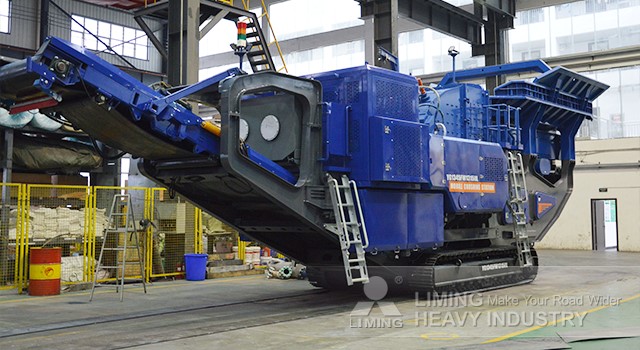
3. Terrain and Conditions to Avoid or Approach with Caution
a) Soft, Uneven, or Sloppy Ground
- Mud, loose sand, deep gravel, or saturated soil.
- Risk: The tires will sink, causing instability, dangerous tilting, and making the plant immobile. Extensive and costly ground preparation (e.g., laying geotextile and gravel mats) would be necessary.
b) Steep or Unstable Slopes
- Wheeled plants have limited leveling capability and are not designed for operation on significant inclines. Their outriggers require firm, level ground to stabilize the unit safely during crushing.
c) Extremely Rocky or Uneven Natural Terrain
- Risk: Sharp rocks can damage tires, and the uneven surface makes it difficult to achieve a safe, level operating position without major site leveling.
d) Remote Sites with Poor or No Road Access
- If the plant cannot be driven on its own wheels to the exact location, the advantage of wheeled mobility is lost. In such cases, a tracked plant that can travel under its own power on rough terrain is superior.
4. Key Comparison: Wheels vs. Tracks for Terrain
| Terrain / Condition | Wheel-Mounted Plant | Track-Mounted Plant |
|---|---|---|
| Public Highway Transport | Excellent. Faster, cheaper, no low-loader needed. | Poor. Requires low-loader transport, slower, more expensive. |
| Prepared Hard Surfaces | Excellent. Stable, fast setup. | Very Good. |
| Soft/Muddy Ground | Unsuitable. Will sink/become stuck. | Excellent. Low ground pressure, high traction. |
| Moderately Uneven Ground | Poor. Requires leveling. | Very Good. Tracks conform to terrain, hydraulic leveling. |
| Steep Gradients | Unsuitable. Limited stability. | Good. Can operate on specified slopes with stabilizers. |
| Frequent On-Site Repositioning | Poor. Requires towing by truck. | Excellent. Self-propelled, precise maneuvering. |
5. Decision Framework: Is a Wheel-Mounted Plant Right for Your Terrain?
Ask these questions:
- Can the plant be driven on its wheels directly to the precise work location? (Yes → leans towards Wheels).
- Is the ground at the location firm, stable, and level (or easily made level)? (Yes → leans towards Wheels).
- Will I need to move the plant short distances around the site frequently under its own power? (Yes → leans strongly towards Tracks).
- Is road transport speed and cost between distant sites a major concern? (Yes → leans strongly towards Wheels).
Conclusion: The Specialist for Accessible, Stable Ground
Wheel-mounted mobile crushing plants are ideally suited for terrains that are accessible by road and offer a firm, level operating base. They are the logistical champions for multi-site projects with good infrastructure, urban recycling, and fixed-yard operations where their transport efficiency and cost savings are fully realized.
However, they are not “go-anywhere” machines. For challenging, soft, or constantly changing terrain, the superior traction and self-leveling capabilities of a track-mounted plant make it the necessary choice. Ultimately, selecting the right mobile crusher begins with an honest assessment of the ground conditions and transport logistics of your project. Matching the plant’s mobility system to the terrain is the first step toward a productive and profitable operation.
- > How Much Does a 100 Tons Per Hour Mobile Impact Crushing Station Cost?
- > Which Construction Projects are Mobile Impact Crushers Best Suited For?
- > The Utilization of Hammer Crushers in Limestone Mining Operations
- > Should an Impact Crusher or a Cone Crusher be used for crushing river pebbles into sand?
- > The Role of Jaw Crushers in Efficient Rock Crushing Processes
- > What equipment is required to crush copper ore from 300 mm down to 10 mm?
- > VSI Vertical Shaft Impact Crusher for Particle Shape Optimization in Concrete Aggregates
- > High-Quality Stone Vibrating Feeder: The ZSW Series


Online


Message