
Processing high-silica rock-type variants like granite at a consistent rate of 250 tons per hour demands an architectural layout that directly respects material science. Granite possesses high compressive strength and severe abrasiveness. Without a balanced, multi-stage reduction circuit, operations face skyrocketing wear costs and frequent unscheduled downtime. This layout optimizes mass-flow balance to maintain a stable aggregate output while keeping expenditure per shift within planned operational parameters.
Circuit Design: Handling the Realities of High-Quartz Ore
The primary engineering objective for a 250 tons per hour plant is mitigating the immense impact forces and frictional wear caused by high-quartz granite run-of-mine feed. A single-stage or poorly matched layout fails rapidly under these conditions. The material-specific layout utilizes a primary jaw crushing phase to handle structural reduction, followed by a secondary hydraulic cone crushing stage configured in a closed circuit with heavy-duty vibrating screens to govern final aggregate sizing and cubical particle shape.
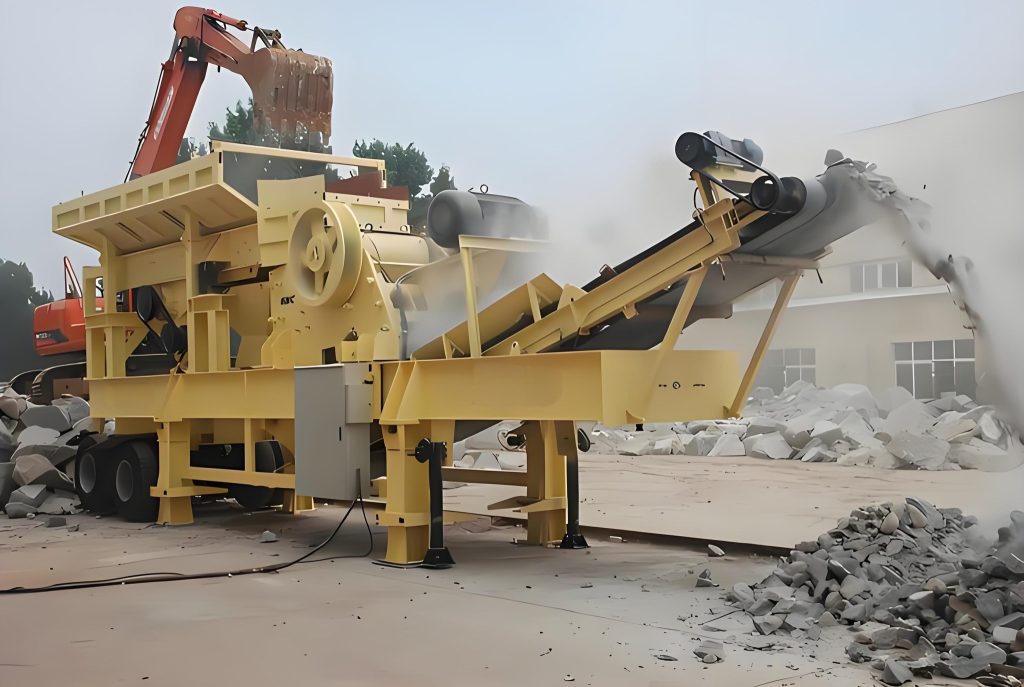
When raw granite blocks drop into the primary station, the distinct metallic screech of high-quartz ore hitting manganese jaw liners highlights the raw kinetic energy required for the initial reduction. The primary jaw crusher must feature a deep crushing cavity and an optimized stroke to aggressively downsize large boulders down to a manageable transfer size, shielding the downstream secondary circuit from catastrophic oversize blockages.
Synchronized Equipment Matrix
Achieving a true, unbottlenecked 250 tons per hour throughput means every single unit must balance perfectly within the mass-flow equation. The table below represents the exact structural blueprint required for this specific production volume, pulling verified machine capabilities directly from our global engineering database.
| Process Stage | Recommended Model | Capacity (tons per hour) | Max Feed (millimeters) | Power (kilowatts) |
|---|---|---|---|---|
| Primary Crushing Stage | PE900×1200 Jaw Crusher | 220-450 tons per hour | 750 millimeters | 110 kilowatts |
| Secondary Crushing Stage | HPT300 Hydraulic Cone Crusher | 115-440 tons per hour | 230 millimeters | 250 kilowatts |
| Integrated Screening Stage | 4XYZ2460 Vibrating Screen | 200-600 tons per hour | 400 millimeters | 30 kilowatts |
Balancing Mass Flow and Shielding Components From Frictional Failure
Downstream from the primary station, the pre-crushed granite moves via heavy belt conveyors to the secondary crushing circuit. Here, a high-efficiency hydraulic cone crusher applies material-bed inter-particle crushing. The rock layers crush against each other inside the chamber rather than just rubbing directly against the steel mantle and bowl liners. This specific crushing dynamic directly preserves the life of expensive alloy components and maintains excellent cubical shape across all finished aggregate fractions.
Unscreened materials exit the secondary cone crusher and travel immediately onto a heavy-duty, multi-deck vibrating screen operating in a tight closed loop. Oversize products are systematically rejected and returned to the cone crusher for re-processing. This prevents any out-of-specification shapes or elongated slabs from contaminating the final stockpiles. By optimizing the close-side settings of the secondary machines relative to the screen mesh selections, the circuit eliminates recirculating material overloads, protecting your upfront equipment investment from premature fatigue failures.
Frequently Asked Engineering Questions
Why choose a hydraulic cone crusher over an impact crusher for 250 tons per hour granite processing? Granite features a high silica content that causes extreme abrasive wear. Impact crushers rely on high-velocity blow bar impacts, which leads to excessive wear part consumption when handling granite. Hydraulic cone crushers utilize high-pressure inter-particle compression, significantly lowering the overall component replacement expenditure per shift. What maximum feed size can this specific primary jaw crusher configuration accommodate? The primary PE900×1200 jaw crusher built into this 250 tons per hour layout comfortably accepts run-of-mine granite blocks measuring up to 750 millimeters along their longest axis, ensuring dependable feed acceptance without requiring manual secondary breaking at the hopper. How does the closed-circuit layout impact the final product shape of the aggregate? By returning oversize material systematically to the HPT300 hydraulic cone crusher, the material-bed density inside the crushing chamber remains completely full. This high-density compression improves the cubical quality of the output, reducing flaky or needle-like particle shapes to meet strict international concrete aggregate specifications.
- > Jaw Crusher with a Capacity of 80 Cubic Meters Per Hour: Applications and Benefits
- > Performance of Hydraulic Cone Crushers in Gold Ore Processing
- > Application of Mobile Impact Crushers in Construction Waste Processing
- > Which Crusher to Use for Manufactured Sand Production? A Complete Guide
- > Mobile Impact Crusher for Construction Waste Recycling: An Efficient Solution
- > Comprehensive Guide to Installation and Commissioning of Mobile Crushing Stations
- > Selection and Maintenance Guidelines for Cone Crusher Lubricating Oil
- > Efficient Material Processing with Russian Mobile Jaw Crushers


Online


Message