
The demolition of buildings, roads, and infrastructure generates massive quantities of waste, historically destined for landfills. Today, the paradigm has shifted towards recycling and circular economy principles. Mobile impact crushers have emerged as the frontline technology for transforming this waste into valuable secondary raw materials directly on the demolition site. However, not all demolition debris is equally suited for this type of crusher. This article provides a clear guide to the specific types of demolition waste materials that are highly suitable for processing with a mobile impact crusher, explaining the “why” behind each match and highlighting key considerations for successful operation.
1. The Ideal Profile: Materials Matching Impact Crushing Mechanics
Mobile impact crushers excel at processing brittle, non-metallic materials of low to medium hardness and abrasiveness. Their high-speed rotor and impact-breaking action are perfect for materials that fracture easily upon impact rather than deforming or being highly abrasive. The mobility adds the crucial advantage of processing these materials directly at the source.
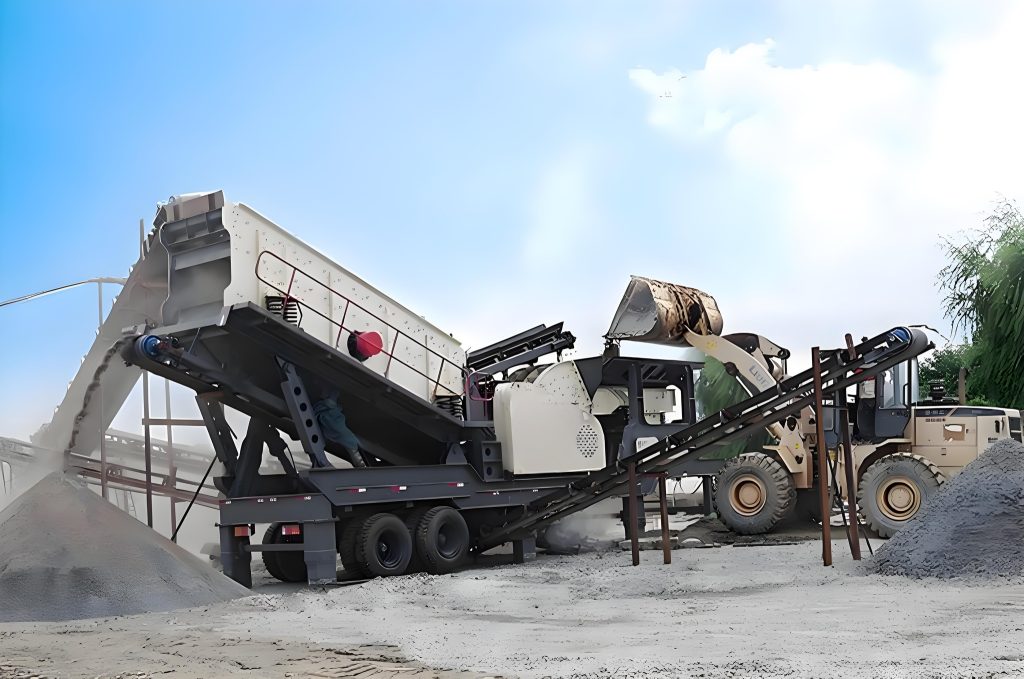
2. Primary Suitable Materials for Mobile Impact Crushers
2.1. Reinforced Concrete (The Primary Application)
This is the most common and economically significant application.
- Why it’s suitable: Concrete is a composite material with a brittle matrix (cement paste and aggregates). The impact force effectively breaks apart the concrete, liberating the embedded steel reinforcement (rebar, mesh).
- Process & Outcome: The crusher reduces concrete chunks to specified sizes (e.g., 0-32mm, 0-63mm). An integrated or standalone overband magnet seamlessly extracts the liberated steel for scrap recycling. The output is clean, high-quality Recycled Concrete Aggregate (RCA) for use as road base, sub-base, or in new concrete (subject to standards).
2.2. Asphalt (Asphalt Milling / RAP)
Processing reclaimed asphalt pavement (RAP) is another perfect fit.
- Why it’s suitable: Asphalt is a viscoelastic material that becomes brittle when cold or aged. Impact crushing efficiently breaks it down without excessive generation of fine filler, preserving the valuable bitumen coating on the aggregate.
- Process & Outcome: Produces precisely graded RAP, which can be stockpiled for hot or cold recycling in new asphalt mixes, significantly reducing the need for virgin binder and aggregate.
2.3. Masonry: Brick, Block, and Tile
Demolition waste from brick buildings, partitions, and ceramics.
- Why it’s suitable: Clay bricks, concrete blocks, and ceramic tiles are generally brittle and of low abrasiveness. An impact crusher can process them into a consistent, granular material.
- Process & Outcome: Creates a masonry sand or aggregate useful for drainage layers, pipe bedding, hard landscaping, or as a filler material. It is often less structurally sound than concrete aggregate but perfect for many non-load-bearing applications.
2.4. Mixed Construction & Demolition (C&D) Waste (With Pre-Sorting)
A well-sorted stream of the above materials.
- Crucial Pre-Condition: Success depends on effective pre-sorting and removal of contaminants (see section on unsuitable materials). A mixed pile containing primarily concrete, asphalt, and clean masonry can be processed efficiently.
- Process & Outcome: Produces a mixed recycled aggregate, often used as general fill or capping material. For higher-value output, source separation is always preferred.
3. Key Unsuitable or Problematic Materials
Understanding limitations is vital for protecting the equipment and ensuring quality output.
- Reinforcing Steel (Pre-Crushing): While liberated rebar is extracted by magnets, large, concentrated masses of steel (beams, columns) must be removed before crushing to avoid catastrophic damage.
- Wood, Plastics, Insulation, Gypsum Board: These are contaminants. They do not crush properly, reduce aggregate quality, can cause blockages, and pose fire risks. They must be removed during pre-demolition sorting.
- Highly Abrasive Materials: Demolition debris containing large quantities of natural stone, granite, or high-silica sand will cause accelerated wear on blow bars and impact plates, increasing operating costs. While possible, it’s less ideal.
- Soil and Organic Matter: Soil clogs screens and contaminates aggregate. It should be stripped separately.
4. Why “Mobile” Makes the Difference for Demolition Waste
The choice of a mobile impact crusher is strategic for demolition projects:
- On-Site Processing: Eliminates all costs associated with transporting heavy, bulky untreated waste to distant processing yards.
- Flexibility: The unit can be moved around large sites or between multiple small sites as projects evolve.
- Immediate Resource Creation: Produces usable material right where it’s needed, for on-site backfilling or sale, closing the loop instantly.
5. Factors for Successful Processing
To maximize the benefits when processing suitable materials:
- Pre-Sorting is Mandatory: Implement a strict waste management plan to separate unsuitable materials before crushing.
- Use an Overband Magnet: This is non-negotiable for concrete recycling to recover steel and protect downstream conveyors.
- Feed Size Control: Use a hydraulic hammer or pulverizer to break down oversize slabs to a manageable size for the crusher’s feed opening.
- Monitor Wear Parts: The presence of some abrasive contaminants is inevitable. Regularly check and rotate/replace blow bars to maintain product quality and crusher efficiency.
Conclusion
Mobile impact crushers are exceptionally well-suited for processing the core, high-volume components of demolition waste: clean reinforced concrete, asphalt (RAP), and masonry. Their technology is uniquely matched to the brittle nature of these materials, enabling efficient size reduction and the liberation of metals for recycling.
The combination of impact crushing mechanics and site mobility creates a powerful economic and environmental proposition for demolition contractors and recycling operators. By focusing on suitable materials and employing proper pre-sorting and operational practices, a mobile impact crusher transforms a demolition site from a cost center (waste disposal) into a productive hub for generating valuable, in-demand recycled aggregates, driving sustainability and profitability simultaneously.
- > Innovative Mobile Cone Crushers in Algeria: Transforming the Mining and Construction Industries
- > Application of Multi-cylinder Cone Crusher in Hard Rock Crushing
- > Comparison Between Impact Crushers and Cone Crushers: Key Differences and Applications
- > Deep Cavity Jaw Crusher for Basalt Processing: High Efficiency and Durability
- > Which crushing machine is suitable for wet and sticky materials
- > Cone Crushers for Aggregate Crushing: The Essential Tool for High-Quality Production
- > Aplicación de Trituradoras Móviles para Basalto, Caliza y Cuarzo en la Industria de Agregados
- > How Effective Are Mobile Impact Crushers for Crushing Concrete Blocks?


Online


Message