
Run a primary crushing station on the Zambian Copperbelt and you know the drill: the rock does not care about your production schedule. High-grade copper deposits in regions like Solwezi or Kitwe carry heavy silica content and tough mineral matrices. If your primary pit infrastructure is weak, this ore will shred your wear liners and snap your shafts before the morning shift change. Handling this harsh material requires aggressive compression mechanics rather than impact forces. That is why heavy-duty jaw crushers remain the baseline standard for the opening stage of regional copper production lines.
The primary station must swallow run-of-mine boulders and spit out a manageable aggregate stream without choking. When dealing with raw Zambian copper ore, the choice of primary reduction machinery dictates your daily running costs and your overall capital payback velocity.
Combating Severe Abrasive Wear on Moving and Fixed Jaw Plates
Zambian copper ore is notoriously abrasive, generating high friction that destroys standard manganese liners rapidly. Jaw crushers handle this by applying straight, high-tonnage compressive force between a fixed and a moving jaw die. This design limits sliding friction compared to rotary or impact designs, directly reducing the rate of metal loss during rock reduction.
High-performance jaw units utilize heavy manganese jaw plates alloyed with chromium to withstand continuous scraping under load. The tooth profile of these plates is engineered to concentrate the compressive force on specific points of the copper ore boulder, fracturing the rock along its natural mineral boundaries. By matching the jaw profile to the high compressive strength of local copper-bearing formations, operators reduce expenditures per shift on spare parts and prevent premature liner deformation.
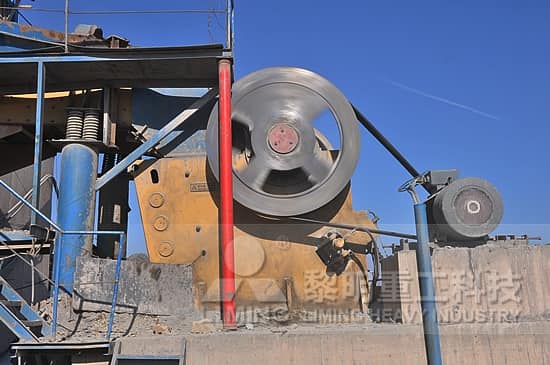
Heavy-Duty Eccentric Shaft Reliability Under High Compressive Loads
The entire load of fracturing tough copper-bearing rock falls directly on the internal drive network. At the center of this mechanism is a heavy-duty forged eccentric shaft. In tough mining environments, a standard shaft will flex, heat up, and eventually suffer catastrophic fatigue failure.
Industrial-grade primary jaw units combat this stress through massive, dynamically balanced eccentric shafts forged from high-strength alloy steel. Supported by heavy-aligned spherical roller bearings, this assembly absorbs the extreme radial forces generated when the pit-man swings forward to crush a dense block of ore. This heavy-duty shaft build preserves critical internal alignment, keeps grease seals intact, and keeps the machine running continuously without unexpected structural failures.
Eliminating Un-Scheduled Downtime Caused by Wedged Boulders
Nothing stalls a pit faster than a massive copper ore boulder wedging itself tight inside the crushing chamber. In an impact mill or a light-duty crusher, clearing a bridged feed requires manual labor, cranes, or blasting, halting your material flow and causing expensive un-scheduled downtime.
Modern heavy-duty jaw crushers solve this bridging issue through deep-chamber geometry and aggressive nipping angles. The steep alignment ensures that even oversized rocks are immediately gripped by the top teeth rather than bouncing inside the feed opening. For the rare instances where a block hangs up, units fitted with hydraulic wedge adjustment systems allow maintenance crews to clear the chamber safely and quickly. This keeps your haul trucks cycling and ensures a steady material flow to the secondary processing stage.
| Crusher Series & Model | Maximum Feed Size (mm) | Crushing Capacity (tph) | Drive Motor Power (kW) | Machine Weight (T) |
|---|---|---|---|---|
| C6X125 Jaw Crusher | 800 | 260–750 | 160 | 31.5 |
| C6X160 Jaw Crusher | 1020 | 410–1020 | 250 | 56.6 |
| PE1200×1500 Jaw Crusher | 1020 | 400–800 | 220 | 100.9 |
| NK100E Mobile Station (PE3040) | 680 | 150–350 | 138.5 | 35 |
Table 1: Primary Heavy-Duty Technical Specifications for Zambian Copper Ore Reduction.
Field-Proven Performance Data in Heavy Mining Operations
Selecting a primary machine requires reviewing field-verified technical data. For massive pit operations requiring high throughput, the C6X160 Jaw Crusher accepts a maximum feed size of 1020 mm, allowing it to process massive run-of-mine boulders directly from the blast site. Operating with a 250 kW drive motor, this machine delivers a crushing capacity between 410 tph and 1020 tph, providing a high production-to-cost ratio for massive copper processing plants.
For operations that require moving the crushing station closer to changing mine faces, the NK100E Mobile Jaw Station offers a flexible alternative. Built with a heavy-duty PE3040 jaw crusher inside, it handles a maximum feed size of 680 mm and outputs a crushing capacity of 150 to 350 tph. Driven by a 138.5 kW power layout and weighing 35 T, this system eliminates the upfront equipment price of fixed concrete foundations while maintaining the structural durability needed to handle abrasive copper rock.
Choosing these high-spec configurations ensures your primary stage provides a steady, reliable product stream, protecting downstream equipment and maximizing your overall plant efficiency.
Frequently Asked Questions Regarding Primary Copper Ore Crushing
How do you prevent jaw plate packing when handling wet copper ore run-of-mine? Wet fines mixed with sticky clay will pack the bottom of the crushing chamber, spiking jaw pressure. We solve this by installing a vibrating grizzly feeder ahead of the jaw crusher to bypass material smaller than 100 mm. Modifying the tooth profile to a sharper, wider configuration also helps release sticky ores cleanly at the discharge outlet. What causes premature cracking in a heavy-duty eccentric shaft assembly? Shaft failure usually traces back to operating with loose flywheel wedges or running the machine with worn-out bronze bush components. Over-tightening the drive belts or allowing uncrushable tramp iron into the jaw cavity also creates extreme stress spikes that can crack the forged steel shaft. Why is a deep-chamber jaw crusher design preferred over shallow designs for copper ore? A deep crushing chamber provides a tight, optimized nipping angle from the top feed opening down to the discharge point. This prevents slick, hard copper boulders from slipping upward under pressure, ensuring immediate rock fracture and maximizing your hourly throughput.
- > Jaw Crusher Anti-Clogging Techniques for High-Viscosity Indonesian Slag
- > Advantages of Using Cone Crushers in Pakistan’s Mining Industry
- > Comprehensive Guide to Choosing the Right Jaw Crusher Model
- > Applications and Advantages of Jaw Crushers in South American Mining Operations
- > Tracked Mobile Crusher for Construction Waste Recycling in the Philippines
- > How to Choose the Right Front-End Crushing Equipment for Your Sand-Making Line
- > Adaptability of Jaw Crushers to High-Moisture Content Materials
- > The Role of Vibrating Feeders: Enhancing Efficiency in Material Handling


Online


Message