
For aggregate production, demolition recycling, or mining in remote or challenging landscapes, simply getting the crushing equipment to the material source is often the first and biggest hurdle. Fixed plants are immobile, and traditional wheeled units can struggle with uneven, soft, or steep ground. This is where the track-mounted mobile crushing station demonstrates a decisive advantage. Designed as true off-road industrial machines, these plants offer unparalleled cross-country mobility and terrain accessibility. This article explores the engineering principles and key features that enable track-mounted crushers to operate effectively in the world’s most rugged and demanding environments.
1. The Core Advantage: The Crawler Track System
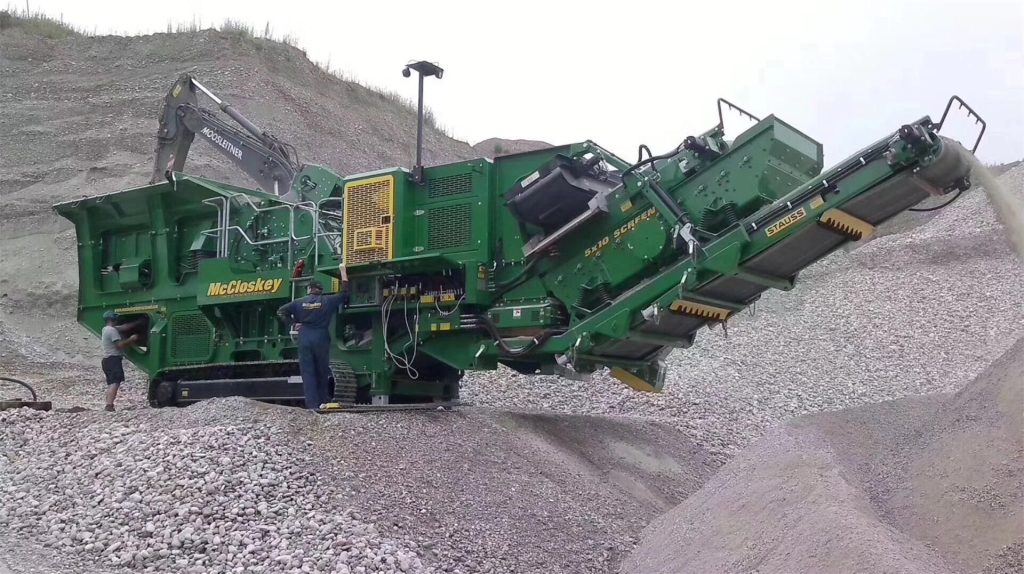
The defining feature is the heavy-duty crawler undercarriage, a technology proven in the most extreme conditions.
- Low Ground Pressure: The machine’s weight is distributed over a large contact area of the track pads. This results in a very low ground pressure (often comparable to a human footprint), allowing the plant to traverse soft, muddy, or sandy ground that would immobilize wheeled equipment or require extensive ground preparation.
- Continuous Track Contact: Unlike wheels that can lose traction over gaps or bumps, the continuous track maintains constant contact with the ground, providing superior grip and stability on uneven surfaces.
- Independent Track Operation: Each track is powered independently. By driving one track forward and the other in reverse, the plant can perform zero-radius, on-the-spot turns, providing exceptional maneuverability in confined spaces on rough terrain.
2. Key Capabilities for Rough Terrain Operation
The design of track-mounted plants incorporates several elements specifically for off-road performance.
- Excellent Gradability: These units are engineered to work on significant slopes. With stable tracks and a low center of gravity, they can safely operate on inclines where wheeled units would risk tipping, enabling direct work on quarry faces or hillsides.
- Ground Clearance and Approach/Departure Angles: Similar to off-road vehicles, track-mounted crushers feature high ground clearance and optimized approach/departure angles. This prevents the chassis from getting hung up on obstacles like rocks, stumps, or ridges when moving across broken ground.
- Self-Propulsion and On-Site Mobility: With their own powerful diesel-hydraulic drives, they move under their own power at walking speed around the site. This allows the operator to “follow the face” in a quarry or reposition the crusher closer to new feed stockpiles without needing a tow truck or low-bed trailer.
- Integrated Feeder and Hopper: The tracked chassis typically integrates a heavy-duty vibrating feeder and a large hopper. This allows for direct feeding by an excavator or wheel loader, even on uneven ground, ensuring a consistent material flow.
3. Applications in Challenging Environments
This terrain capability unlocks opportunities in specific, difficult sectors:
- Remote Quarrying and Mining: Accessing small or remote mineral deposits where building roads for fixed plants is cost-prohibitive. The plant can be transported in modules and assembled on-site, then move under its own power.
- Demolition and Recycling in Confined/Urban Sites: Navigating through rubble, across demolished slabs, and in tight spaces on industrial brownfield sites.
- Infrastructure Projects in Mountainous or Forested Areas: Road and railway construction projects through difficult topography can set up crushing operations right along the corridor, using local rock.
- Disaster Recovery and Emergency Work: Rapid deployment to process collapsed building materials or clear debris in areas where infrastructure is damaged.
4. Benefits Beyond Simple Mobility
The ability to conquer rough terrain translates into direct operational and financial benefits.
- Reduced Site Preparation Costs: Eliminates or drastically reduces the need for building expensive, leveled permanent foundations or stable platforms for the plant.
- Lower Haulage Costs: By moving the crusher to multiple piles or directly to the extraction point, it minimizes the distance loaders or trucks need to transport unprocessed material.
- Increased Flexibility and Project Viability: Makes smaller, shorter-duration projects in difficult locations economically feasible.
- Faster Setup and Relocation: The plant can be ready to crush within hours of arrival and can be moved around a large site as needed with minimal downtime.
5. Considerations for Optimal Performance
To maximize capability and lifespan in harsh conditions, certain factors are crucial:
- Undercarriage Maintenance: Track components (pads, rollers, sprockets) are wear items. Regular inspection and maintenance are essential, especially when working in highly abrasive conditions.
- Operator Training: Skilled operation is key to navigating slopes and obstacles safely and efficiently, and to avoid damaging the undercarriage.
- Material Feed Management: Even on slopes, ensuring even and controlled feeding to the crusher chamber is necessary to prevent uneven wear and maintain product quality.
Conclusion
The cross-country capability of track-mounted crushing stations is not merely a feature—it is a fundamental game-changer for material processing in non-standard environments. By combining the proven off-road performance of crawler tracks with fully integrated crushing and screening modules, these plants deliver unmatched accessibility, mobility, and operational flexibility.
For contractors and producers facing projects with challenging geography, limited infrastructure, or dynamic worksites, the track-mounted crusher is the definitive solution. It transforms difficult terrain from a prohibitive obstacle into a viable worksite, ensuring that crushing power can be deployed precisely where and when it is needed most. In the realm of mobile processing, it represents the ultimate in terrain-conquering capability.
- > Selection and Maintenance Guidelines for Cone Crusher Lubricating Oil
- > The Role of Impact Crushers in Construction and Demolition Waste Processing
- > The Unmatched Convenience of Mobile Jaw Crushers for Mountain Road Construction
- > Durable Hydraulic Spring Cone Crusher for Mining Applications
- > Multi-Cylinder Hydraulic Cone Crusher for Hard Granite Crushing
- > Can a Crawler Mobile Crushing Station Be Used for Construction Waste Recycling?
- > The Role of Impact Crushers in Sand and Gravel Aggregate Production
- > PE 250×400 Jaw Crusher for Gravel Production Lines


Online


Message