
Processing 300mm raw stones (also known as raw ore or boulders) is a common requirement in mining, construction, aggregate production, and infrastructure projects. As the primary crushing equipment, jaw crushers are widely used for breaking large raw stones into coarse aggregates due to their simple structure, high durability, low maintenance costs, and strong adaptability to various raw materials. However, choosing the right jaw crusher model for 300mm raw stones is crucial—it directly affects crushing efficiency, product quality, operational stability, and long-term cost-effectiveness. This article provides a detailed guide to help you select the most suitable jaw crusher model for processing 300mm raw stones, covering key selection criteria, recommended models, parameter analysis, and practical application tips.
Before selecting a jaw crusher model, it is essential to clarify the core requirements of your processing project: the size of raw stones (fixed at 300mm here), desired final product size, daily output, raw material hardness (e.g., limestone, granite, basalt, river pebbles), and site conditions. For 300mm raw stones, the key factor in jaw crusher selection is the maximum feed size of the equipment—this must be larger than 300mm to ensure smooth feeding and avoid clogging. Additionally, the crusher’s capacity, discharge size adjustability, and durability should match your project’s specific needs.
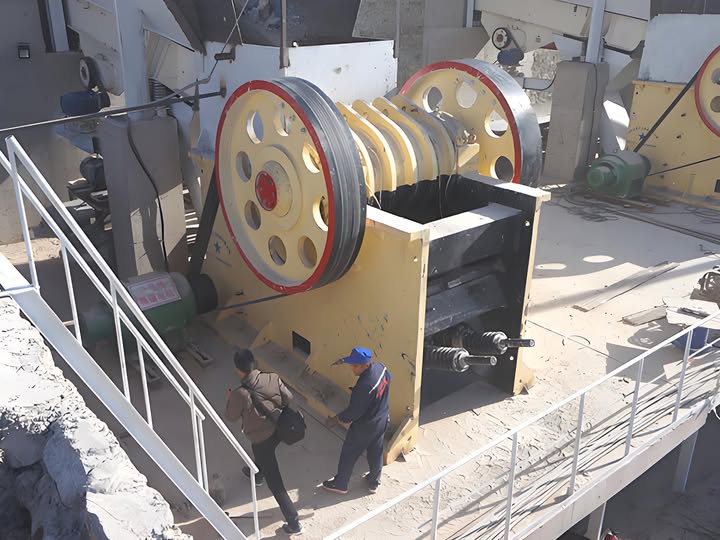
Key Selection Criteria for Jaw Crushers Processing 300mm Raw Stones
When choosing a jaw crusher for 300mm raw stones, focus on the following four core criteria to ensure optimal performance and cost-effectiveness:
- Maximum Feed Size: The most critical criterion. The jaw crusher’s maximum feed size must be ≥ 300mm (preferably 350-400mm) to accommodate 300mm raw stones without blocking the feeding port. If the maximum feed size is smaller than 300mm, the raw stones will need to be pre-crushed, increasing operational costs and reducing efficiency.
- Crushing Capacity: Match the crusher’s hourly capacity to your daily output requirements. For example, if your daily output target is 500-1000 tons (working 8-10 hours a day), choose a jaw crusher with an hourly capacity of 60-120 tons. For larger output (1000-2000 TPD), select a higher-capacity model.
- Discharge Size Adjustability: The jaw crusher should allow flexible adjustment of the discharge size to meet different final product requirements (e.g., 50-100mm for secondary crushing, 30-50mm for direct use as coarse aggregates). Hydraulic adjustment systems are preferred for easy, quick adjustments.
- Durability and Wear Resistance: Choose a jaw crusher with a heavy-duty frame, wear-resistant jaw plates (e.g., manganese steel), and a reliable transmission system. This ensures the equipment can handle hard raw materials (e.g., granite, basalt) and reduces maintenance costs and downtime.
Recommended Jaw Crusher Models for Processing 300mm Raw Stones
Based on the above selection criteria, we recommend three high-performance jaw crusher models that are perfectly suitable for processing 300mm raw stones. These models cover different capacity ranges, making them suitable for small-to-medium and medium-to-large scale projects:
1. PE 600×900 Jaw Crusher (Ideal for Small-to-Medium Scale Projects)
The PE 600×900 jaw crusher is a classic model widely used in small-to-medium scale crushing projects. It is compact in structure, easy to install and maintain, and perfectly adapted to processing 300mm raw stones.
- Key Parameters:
- Maximum Feed Size: 500mm (sufficiently accommodates 300mm raw stones)
- Crushing Capacity: 40-110 TPH (hourly)
- Discharge Size: 60-160mm (adjustable, meeting most coarse aggregate requirements)
- Motor Power: 75kW
- Weight: Approximately 26 tons
- Suitable Scenarios: Small aggregate plants, construction waste recycling, small mining projects, and projects with daily output of 300-800 tons. Ideal for processing medium-hard raw materials such as limestone, dolomite, and river pebbles.
- Advantages: Low investment cost, simple operation, easy maintenance, and stable performance. The manual or hydraulic adjustment system allows quick discharge size adjustment to adapt to different product needs.
2. PE 750×1060 Jaw Crusher (Ideal for Medium Scale Projects)
The PE 750×1060 jaw crusher is a medium-capacity model with higher efficiency and stronger durability, suitable for medium-scale projects processing 300mm raw stones.
- Key Parameters:
- Maximum Feed Size: 630mm (easily handles 300mm raw stones, even with occasional larger blocks)
- Crushing Capacity: 110-320 TPH (hourly)
- Discharge Size: 80-140mm (adjustable, suitable for secondary crushing or direct use)
- Motor Power: 110kW
- Weight: Approximately 45 tons
- Suitable Scenarios: Medium-sized aggregate plants, mining projects, road construction, and projects with daily output of 800-2000 tons. Suitable for processing medium-to-hard raw materials such as granite, basalt, and quartzite.
- Advantages: High crushing efficiency, large capacity, wear-resistant jaw plates, and a hydraulic adjustment system for easy operation. The heavy-duty frame ensures stable operation even under long-term high-load conditions.
3. PE 900×1200 Jaw Crusher (Ideal for Large Scale Projects)
The PE 900×1200 jaw crusher is a large-capacity model designed for large-scale crushing projects, suitable for processing 300mm raw stones with high efficiency and stability.
- Key Parameters:
- Maximum Feed Size: 750mm (handles 300mm raw stones with ease, suitable for projects with mixed raw stone sizes)
- Crushing Capacity: 220-500 TPH (hourly)
- Discharge Size: 100-200mm (adjustable, ideal for primary crushing in large aggregate plants)
- Motor Power: 160kW
- Weight: Approximately 85 tons
- Suitable Scenarios: Large aggregate plants, large-scale mining projects, infrastructure construction, and projects with daily output of 2000-4000 tons. Suitable for processing hard, abrasive raw materials such as granite, basalt, and diabase.
- Advantages: Ultra-high capacity, strong crushing force, long service life, and advanced hydraulic protection system. It can operate continuously for a long time, reducing downtime and improving overall project efficiency.
How to Choose the Right Model for Your Project?
To select the most suitable jaw crusher model for processing 300mm raw stones, follow these practical steps to match the model to your project needs:
- Determine Your Daily Output:
- Daily output ≤ 800 tons: Choose PE 600×900 jaw crusher (cost-effective, compact).
- Daily output 800-2000 tons: Choose PE 750×1060 jaw crusher (balanced capacity and cost).
- Daily output ≥ 2000 tons: Choose PE 900×1200 jaw crusher (high efficiency, large capacity).
- Consider Raw Material Hardness:
- Medium-hard raw materials (limestone, dolomite): All three models are suitable; prioritize cost-effectiveness (PE 600×900 for small projects, PE 750×1060 for medium projects).
- Hard, abrasive raw materials (granite, basalt): Choose PE 750×1060 or PE 900×1200, which have stronger wear resistance and crushing force.
- Check Site Conditions:
- Small site area: Choose PE 600×900 (compact structure, small footprint).
- Large site area and high output requirements: Choose PE 750×1060 or PE 900×1200.
- Consider Long-Term Costs:
- Small projects with limited budget: PE 600×900 (low initial investment and maintenance costs).
- Large projects with high output requirements: PE 900×1200 (higher initial investment but lower unit crushing cost).
Practical Tips for Using Jaw Crushers to Process 300mm Raw Stones
To ensure the jaw crusher operates efficiently and stably when processing 300mm raw stones, follow these practical tips:
- Pre-Clean Raw Stones: Remove large impurities (e.g., metal, wood, boulders larger than 350mm) from the 300mm raw stones to avoid damaging the jaw plates and blocking the feeding port.
- Control Feeding Speed: Use a vibrating feeder to uniformly feed 300mm raw stones into the jaw crusher, avoiding overload and ensuring the crusher operates at full capacity.
- Adjust Discharge Size Properly: According to the desired final product size, adjust the discharge gap of the jaw crusher. Avoid setting the gap too small, which will increase energy consumption and wear; avoid setting it too large, which will affect product quality.
- Regular Maintenance: Inspect the jaw plates, eccentric shaft, bearing, and other wear parts regularly. Replace worn jaw plates in a timely manner to ensure crushing efficiency and product quality. Lubricate the equipment regularly to reduce friction and extend service life.
- Equip with Dust Removal System: Install a baghouse dust collector to collect dust generated during crushing, meeting environmental protection standards and protecting the health of operators.
Practical Case Study: PE 750×1060 Jaw Crusher Processing 300mm Granite
To illustrate the practical application of the recommended models, we present a case study of a medium-sized aggregate plant in Henan, China, which uses a PE 750×1060 jaw crusher to process 300mm granite:
The plant’s daily output target is 1200 tons, processing 300mm granite into 80-120mm coarse aggregates for road construction. The configuration includes a GZD 1100×4200 vibrating feeder, PE 750×1060 jaw crusher, and DTII belt conveyor.
Results after operation:
- Crushing Efficiency: 150 TPH (hourly), 1200 TPD (daily), meeting the output target.
- Product Quality: The discharged aggregates are uniform in size, with a qualification rate of 97%.
- Operational Stability: The jaw crusher operates continuously for 10 hours a day, with a downtime rate of less than 3%.
- Maintenance Costs: 7-9% of the total operational costs, lower than the industry average.
This case study demonstrates that the PE 750×1060 jaw crusher is perfectly suitable for processing 300mm hard raw stones, delivering high efficiency, stable performance, and cost-effectiveness.
Conclusion
Processing 300mm raw stones requires a jaw crusher with a maximum feed size ≥ 300mm, matching capacity, and strong durability. The PE 600×900, PE 750×1060, and PE 900×1200 jaw crushers are the most recommended models, covering small-to-large scale projects.
When selecting a model, focus on your daily output, raw material hardness, site conditions, and long-term costs. For small projects, the PE 600×900 is cost-effective; for medium projects, the PE 750×1060 balances capacity and cost; for large projects, the PE 900×1200 delivers high efficiency and large capacity. With proper model selection, regular maintenance, and scientific operation, the jaw crusher can efficiently process 300mm raw stones, ensuring project progress and product quality.
If you are unsure which jaw crusher model is most suitable for your 300mm raw stone processing project, our team of experts can provide personalized advice based on your specific output, raw material, and site requirements, helping you select the optimal solution.
- > The Advantages of Multi-Cylinder Hydraulic Cone Crushers in Hard Rock Crushing
- > Kenya’s Mobile Crusher Market: Trends, Drivers, and Opportunities
- > Wheeled vs. Tracked Mobile Crushers: Which is Best for Soft Soil Mining Areas?
- > The Role of Mobile Construction Waste Crusher in Road Renovation Projects
- > PE Jaw Crusher Application in Aggregate Production
- > Puzzolana jaw movable stone crusher
- > Mobile Crushers in Malaysia: Pioneering Iron Ore Grinding Solutions
- > The Role of PF Impact Crushers in Kazakhstan’s Mining Industry


Online


Message