
Hard-Starting 300tph Tonnage in Track-mounted Mobile Jaw Crusher for Sale Deployments
Every hour spent waiting on a concrete mixer is a crime against your capital payback velocity. A stationary plant demands 45 days of civil engineering before a single 600mm boulder is crushed. Deploying a heavy-duty crawler track completely bypasses this paralysis. The VTJ1170 drives straight off the lowboy trailer via wireless remote, deploying hydraulic folding hopper wings to initiate a continuous 260-330 tph extraction cycle within 30 minutes. Mobility is not a luxury; it is the ultimate weapon against logistical hemorrhage.
Zero-Foundation Deployment and the 30-Minute Startup
A 45-day delay for concrete curing is financial suicide for short-term extraction contracts.
Contractors who purchase stationary equipment are buying into an outdated timeline. You have to grade the site, build retaining walls, pour massive concrete footings, and wait weeks for the structural integrity to cure enough to handle a 200kW kinetic strike. That is weeks of zero first-hour tonnage yield.
The track-mounted Vertex series flips this paradigm entirely.
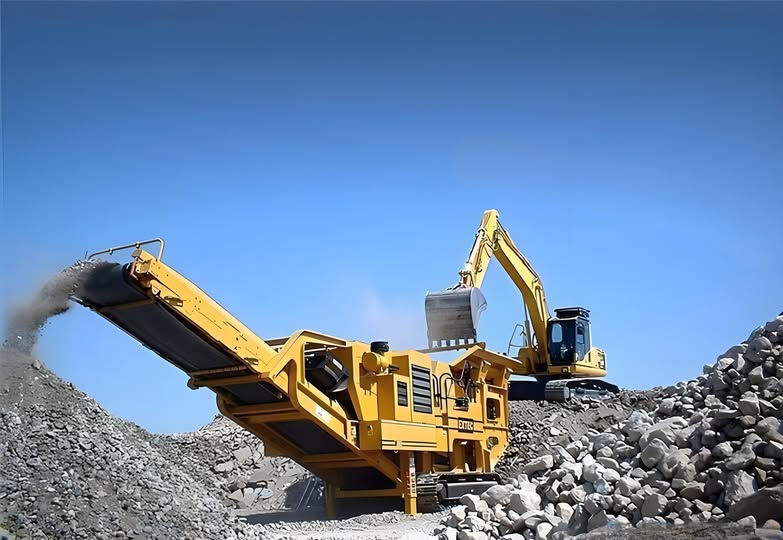
When the lowboy trailer arrives on site, the operator simply picks up the wireless remote. The 45-ton machine tracks down the ramp and crawls directly to the blast face. You press a button on the PLC panel, and the hydraulic cylinders unfold the massive feed hopper walls. The discharge belts extend automatically. In under 30 minutes, the diesel engine is roaring, the 1060×700 jaw is engaged, and the excavator is dropping rock. You bought a crusher to make aggregate, not to wait on civil engineers.
Eradicating the Haulage Diesel Hemorrhage
Relying on dump trucks to haul 600mm boulders across a muddy, unpaved quarry floor guarantees a massive daily diesel hemorrhage. Every time an excavator loads a truck, and that truck drives three kilometers to a fixed primary jaw, you are burning fuel to move raw deadweight. When the blast face advances, a fixed crusher is left behind, elongating the haulage loop and compounding your expenditure per shift.
The heavy-duty crawler tracks of the VTJ1170 solve this by hunting the rock.
You position the 200kW primary jaw inches from the active excavator bucket. As the blast face retreats into the mountain, the crusher tracks forward with it. This “crusher-follows-the-rock” mobility completely eliminates the need for a primary dump truck fleet. The raw feed goes straight into the jaw, and only the processed, value-added aggregate moves onto the secondary circuit. The deployment-to-production ratio is maximized instantly.
Specifying the right crawler chassis guarantees terrain dominance and relentless first-hour tonnage yield.
| Process Stage | Recommended Model | Capacity (tons per hour) | Power (kilowatts) |
|---|---|---|---|
| High-Volume Primary Crawler | VTJ1180 | 340-400 | 250 |
| Standard Primary Crawler | VTJ1170 | 260-330 | 200 |
| Compact Primary Crawler | VTJ9060 | 180-240 | 150 |
Notice the power rating of the VTJ1170. Pushing 200kW through a 1060×700 jaw opening means this machine is not a lightweight toy. It is a genuine high-tonnage primary engine that just happens to be bolted to a pair of invincible steel tracks.
Track Footprint vs. Monsoon Mud
Tire-mounted plants are excellent for paved urban demolition, but they get bogged down or sink when the quarry floor turns to soup during monsoon season. The physics of a pneumatic tire concentrate the machine’s weight onto four small contact patches. In deep mud, tires spin, and the plant becomes an immobilized liability.
The Vertex crawler chassis distributes its weight across an ultra-wide track footprint.
This drastically lowers the ground pressure. The aggressive steel grousers bite into the wet earth, allowing the 45-ton machine to conquer 20-degree inclines effortlessly. It maintains absolute stability while fracturing 200MPa granite, ensuring that weather conditions never dictate your extraction schedule. The moment a contractor buys a track-mounted unit, they buy immunity from bad weather.
Crawler Terrain Dominance & Rapid Deployment Verdict
Capital Freeze: Why is pouring concrete an obsolete extraction strategy?
I watched a contractor lose a massive highway bid because his stationary plant was stuck waiting 45 days for concrete curing. The VTJ1170 drives straight off the lowboy trailer and initiates a 300 tph crushing cycle in under 30 minutes. You eliminate the civil engineering friction and start turning rock into cash immediately.
Logistical Bleed: How do crawler tracks neutralize dump truck expenses?
Hauling raw blast rock across a muddy quarry floor burns diesel and destroys truck suspensions. A crawler crusher tracks forward with the advancing blast face. By positioning the 200kW jaw inches from the active excavator, you eradicate the primary haulage loop, instantly slashing your daily fuel expenditure per shift.
Ground Pressure Physics: Why do wheeled plants fail in monsoon conditions?
Tires concentrate 40 tons of mass into four small patches of mud, causing the axles to sink and spin. The Vertex crawler chassis distributes that massive weight across two ultra-wide steel tracks, drastically lowering ground pressure. This allows the machine to climb 20-degree inclines and remain absolutely stable while fracturing 200MPa granite.
Operational Agility: How does wireless remote steering alter site safety?
Moving a stationary or towable plant requires a dedicated semi-truck and a team of spotters. The VTJ1170 is driven by a single operator wearing a wireless remote control pack. They can walk alongside the 45-ton machine, ensuring perfect visual clearance while maneuvering the crusher into the most aggressive extraction positions.
Buying a stationary plant locks your capital into an unmoving piece of concrete. Acquiring a track-mounted mobile jaw crusher dictates an entirely new level of operational aggression. The heavy-duty crawler tracks of the VTJ1170 allow you to bypass 45-day foundation delays, conquer monsoon mud, and obliterate dump truck haulage expenses. If you deploy a stationary unit next month, the resulting logistical hemorrhage will systematically drain your profit margins. The crawler chassis delivers 300 tph directly at the blast face.
- > Roll Crusher 100TPH: Efficient Crushing Solution for Medium-Scale Operations
- > The Application of Impact Crushers in the Mining Industry
- > Advantages and Disadvantages of Cone Crushers: A Comprehensive Overview
- > Mobile Impact Crusher for Construction Waste Recycling: An Efficient Solution
- > How to Choose Jaw Crusher for Primary Crushing in Mining Plant
- > The Application of Vertical Roller Crushers in the Cement Industry
- > The Unmatched Convenience of Mobile Jaw Crushers for Mountain Road Construction
- > Advantages of Using Mobile Impact Crushers for Iron Ore Processing in Denmark


Online


Message